According to the Institute for Economic Justice, government workers, contractors, or officials are involved in 75% of reported fraud cases.
- Approximately 75% of reported cases of social grant fraud between 2014 and 2025 involved government officials employees, or contractors, according to an analysis by the Institute for Economic Justice.
- However, the IEJ notes that recent anti-fraud initiatives by SASSA and the National Treasury have placed a strong emphasis on beneficiaries.
- Researchers caution that beneficiaries may be incorrectly flagged by automated checks and erroneous databases, which could result in grant suspensions or cancellations.
- Concerns about grant systems being outsourced to private businesses which may grant them access to private beneficiary data, have also been voiced by civil society organizations.
The government is screening recipients in an attempt to combat fraud in the social grant system. However, the majority of fraud cases that have been made public have involved officials and contractors, according to a recent analysis by the Institute for Economic Justice (IEJ).
According to the IEJ the government’s anti-fraud policies run the risk of unjustly denying vulnerable individuals the grants they depend on.

Public data government reports, news coverage, and testimonies from beneficiaries impacted by fraud investigations were all used in the analysis, which was presented at an IEJ webinar.
The researchers discovered that between 2014 and 2025, government employees, contractors, or officials were involved in roughly 75% of the 2,658 social grant fraud cases that were reported for police investigation. Only 590 beneficiaries roughly 54 people annually were reported for fraud during that time. These figures are based on data that the SA Social Security Agency (SASSA) and the DSD provided to Parliament.
According to IEJ researcher Dr. Kelle Howson, “our factsheet argues that the resources being dedicated to policing beneficiary fraud are hugely disproportionate to the problem and, especially given their adverse consequences unjustifiable, given that approximately 28 million people received social grants in 2025.”
Tightening beneficiary verification procedures has been the main focus of recent anti-fraud initiatives. Stricter surveillance biometric checks, bank income verification, and extensive database cross-checks are some of the new measures. Recipients who are identified by these systems might have to go through in-person evaluations at SASSA offices.
The National Treasury has added new requirements to SASSA’s budget that include these measures. The agency is now required to submit quarterly reports that include information on the number of grants that have been reviewed suspended or cancelled as well as the savings that have been achieved.
Finance Minister Enoch Godongwana stated in his budget speech that increased fraud detection efforts had resulted in the review of roughly 292,000 grants, of which about 34,600 had been cancelled.
However, a cancelled grant shouldn’t always be regarded as fraudulent according to researchers.
“Ineligible individuals obtaining social grants are referred to as fraud quite broadly. However, it’s a particular legal term, according to Howson. “Misrepresentation or deceit must occur in order for fraud to be defined legally.”
According to her, in order to profit financially someone must intentionally misrepresent their situation.

For verification, beneficiaries flagged by automated systems frequently have to travel to SASSA offices which can be challenging for the elderly people with disabilities, and those who live far from service centers.
“It doesn’t mean you’ve committed fraud if you show up and are determined to be ineligible for a grant because you’re over the threshold,” Howson remarked.
According to the analysis, rather than because fraud has been proven, many grants are canceled because beneficiaries do not finish the review procedures.
The accuracy of the digital systems used to identify possible fraud was another issue brought up by the IEJ. They claimed that while bank checks are unable to differentiate between various types of money passing through an account, such as child maintenance payments, gifts, or loans, government databases are frequently out-of-date or inaccurate. According to Howson, this means that beneficiaries may be mistakenly flagged as suspicious by these systems.
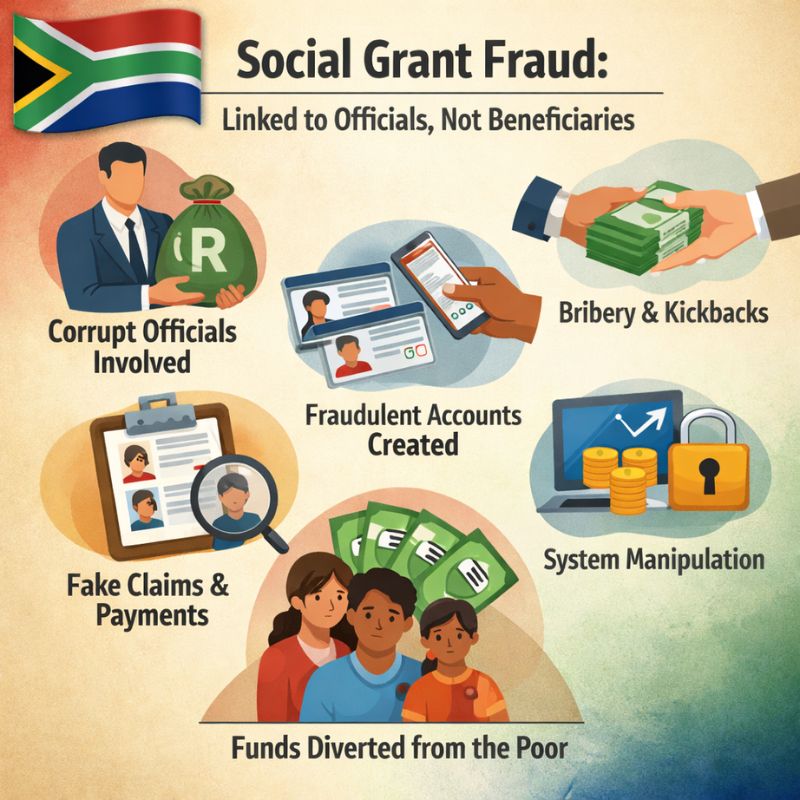
In addition to beneficiary fraud researchers identified other types of systemic misconduct such as beneficiary-targeting scams, fraudulent websites impersonating SASSA to obtain personal information, loan sharks using grants as collateral, and unauthorized deductions for funeral policies.
The state has increasingly outsourced important components of the infrastructure used to administer grants, including systems for applications, reviews, and payments, according to Open Secrets researcher Abby May.
As a result, private businesses that constructed the infrastructure now possess a large portion of the expertise needed to respond to social grant recipients. There is a risk here.
Large volumes of sensitive beneficiary data could be accessed by private businesses participating in these systems, she said.
“What Net1 and CPS demonstrated is that CPS had full access to data flowing throughout the grant system including the grant recipients’ ID information, but more crucially, their financial status and the transactions entering and leaving their bank accounts,” May stated.